The Gardens of Democracy: A New American Story of Citizenship, the Economy, and the Role of Government by Liu Eric & Hanauer Nick
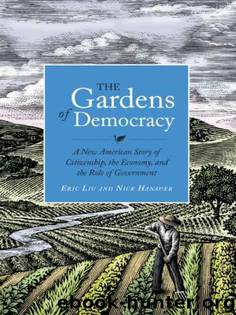
Author:Liu, Eric & Hanauer, Nick [Liu, Eric]
Language: eng
Format: mobi
ISBN: 9781570618437
Publisher: Perseus Books Group
Published: 2011-12-05T16:00:00+00:00
Markets as Machines vs. Markets as Gardens
Understanding economics in this new way can revolutionize our approach and our politics. The shift from mechanistic models to complex ecological ones is not one of degree but of kind. It is the shift from a tradition that prizes fixity and predictability to a mindset that is premised on evolution. Compare two frames in capsule form:
Machine view: Markets are efficient, thus sacrosanct
Garden view: Markets are effective, if well tended
In the traditional view, markets are sacred because they are said to be the most efficient allocators of resources and wealth. Complexity science shows that markets are often quite inefficient—and that there is nothing sacred about today’s man-made economic arrangements. But complexity science also shows that markets are the most effective force for producing innovation, the source of all wealth creation. The question, then, is how to deploy that force to benefit the greatest number.
Machine view: Regulation destroys markets
Garden view: Markets need fertilizing and weeding, or else are destroyed
Traditionalists say any government interference distorts the “natural” and efficient allocation that markets want to achieve. Complexity economists show that markets, like gardens, get overrun by weeds or exhaust their nutrients (education, infrastructure, etc.) if left alone, and then die—and that the only way for markets to deliver broad-based wealth is for government to tend them: enforcing rules that curb anti-social behavior, promote pro-social behavior, and thus keep markets functioning.
Machine view: Income inequality reflects unequal effort and ability
Garden view: Inequality is what markets naturally create and compound, and requires correction
Traditionalists assert, in essence, that income inequality is the result of the rich being smarter and harder working than the poor. This justifies government neglect in the face of inequality. The markets-as-garden view would not deny that smarts and diligence are unequally distributed. But in their view, income inequality has much more to do with the inexorable nature of complex adaptive systems like markets to result in self-reinforcing concentrations of advantage and disadvantage. This necessitates government action to counter the unfairness and counterproductive effects of concentration.
Machine view: Wealth is created through competition and by the pursuit of narrow self-interest
Garden view: Wealth is created through trust and cooperation
Where traditionalists put individual selfishness on a moral pedestal, complexity economists show that norms of unchecked selfishness kill the one thing that determines whether a society can generate (let alone fairly allocate) wealth and opportunity: trust. Trust creates cooperation, and cooperation is what creates win-win outcomes. High-trust networks thrive; low-trust ones fail. And when greed and self-interest are glorified above all, high-trust networks become low-trust. See : Afghanistan.
Machine view: Wealth = individuals accumulating money
Garden view: Wealth = society creating solutions
One of the simple and damning limitations of traditional economics is that it can’t really explain how wealth gets generated. It simply assumes wealth. And it treats money as the sole measure of wealth. Complexity economics, by contrast, says that wealth is solutions: knowledge applied to solve problems. Wealth is created when new ideas—inventing a wheel, say, or curing cancer—emerge from a competitive, evolutionary environment.
Download
This site does not store any files on its server. We only index and link to content provided by other sites. Please contact the content providers to delete copyright contents if any and email us, we'll remove relevant links or contents immediately.
| Elections & Political Process | Ideologies & Doctrines |
| International & World Politics | Political Science |
| Public Affairs & Policy | Specific Topics |
| United States |
The Secret History by Donna Tartt(19012)
The Social Justice Warrior Handbook by Lisa De Pasquale(12179)
Thirteen Reasons Why by Jay Asher(8878)
This Is How You Lose Her by Junot Diaz(6866)
Weapons of Math Destruction by Cathy O'Neil(6254)
Zero to One by Peter Thiel(5778)
Beartown by Fredrik Backman(5723)
The Myth of the Strong Leader by Archie Brown(5488)
The Fire Next Time by James Baldwin(5421)
How Democracies Die by Steven Levitsky & Daniel Ziblatt(5207)
Promise Me, Dad by Joe Biden(5138)
Stone's Rules by Roger Stone(5072)
A Higher Loyalty: Truth, Lies, and Leadership by James Comey(4942)
100 Deadly Skills by Clint Emerson(4908)
Rise and Kill First by Ronen Bergman(4766)
Secrecy World by Jake Bernstein(4735)
The David Icke Guide to the Global Conspiracy (and how to end it) by David Icke(4693)
The Farm by Tom Rob Smith(4496)
The Doomsday Machine by Daniel Ellsberg(4477)
